Pharmacology
Dr. Reddy's Laboratories
Quantitative thinking about how mechanism becomes therapeutic performance.
About me
A neurobiologist with expertise in omics and drug discovery.
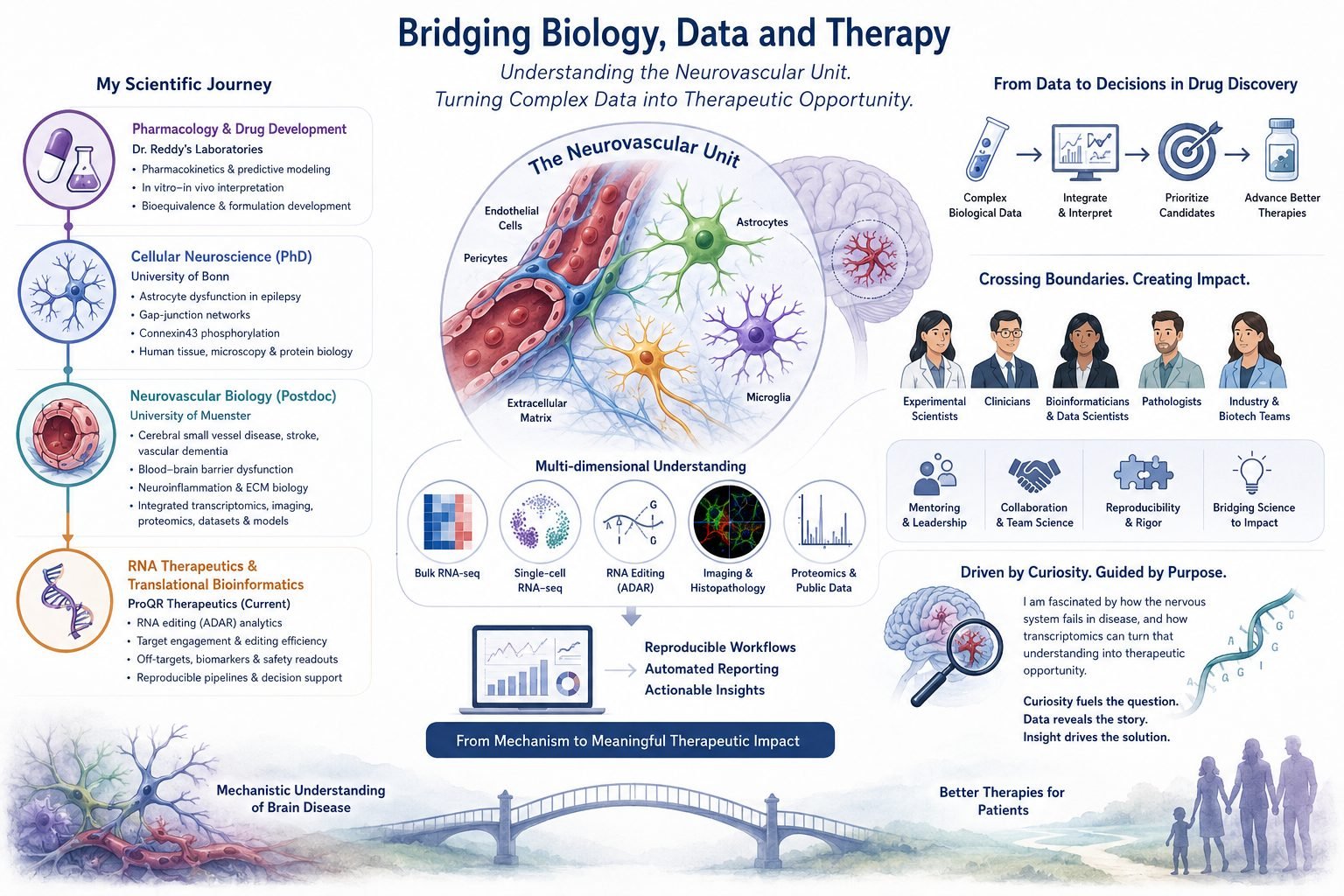
I am a neurobiologist with expertise in omics and drug discovery. My work combines bulk and single-cell RNA-seq, RNA editing, and imaging, to understand the neurovascular unit. Across academia, pharma, and biotech, I have focused on one central goal: translating complex biological data into clear, actionable insight.
I am fascinated by how the nervous system fails in disease, and how transcriptomics can help turn that understanding into therapeutic opportunity.
The longer version
My scientific path began in pharmacology and drug development, where I learned to think quantitatively about how biological mechanisms translate into therapeutic performance. At Dr. Reddy's Laboratories, I worked on pharmacokinetic analysis, predictive modeling, in vitro–in vivo interpretation, and bioequivalence-supporting studies for formulation development. This early industry experience shaped the way I still approach science: with attention to mechanism, reproducibility, decision-making, and translational value.
I then moved into cellular neuroscience during my doctoral research at the University of Bonn, where I studied astrocyte dysfunction in temporal lobe epilepsy. My work focused on how astrocytic gap-junction networks, connexin43 phosphorylation, and cellular communication contribute to epileptogenesis. This period gave me a strong foundation in experimental neurobiology, human tissue analysis, microscopy, protein biology, and disease mechanism discovery.
During my postdoctoral research at the University of Münster, I expanded this focus from astrocytes to the broader neurovascular unit. I worked on cerebral small vessel disease, stroke, vascular dementia, blood-brain barrier dysfunction, neuroinflammation, extracellular matrix biology, and vascular basement membrane specialization. I integrated transcriptomics, imaging, histopathology, proteomics, public dataset reanalysis, and disease models to understand how glial, vascular, immune, and matrix interactions shape brain homeostasis and disease vulnerability.
Currently, I work as a Senior Scientist and Project Leader in Bioinformatics at ProQR Therapeutics, where I support RNA-editing therapeutic programs in liver and CNS disease. My work includes analysis of ADAR-mediated RNA editing, target engagement, editing efficiency, isoform effects, off-target signatures, biomarker signals, and transcriptomic safety readouts. I also develop reproducible computational workflows and automated reporting systems that help translate complex datasets into candidate selection, lead prioritization, and cross-functional project decisions.
What connects these different stages of my career is a belief that important biological questions rarely fit within one discipline. I enjoy working where computation meets biology, where experimental data meet clinical relevance, and where mechanistic insight can guide therapeutic strategy. I bring together experience in bioinformatics, neurobiology, vascular biology, pharmacology, RNA therapeutics, imaging, pathology, and translational science to help teams ask sharper questions and make better decisions.
Beyond technical work, I value scientific leadership, mentoring, and collaboration. I have worked with academic consortia, biotechnology project teams, clinicians, pathologists, experimental scientists, data scientists, and translational colleagues. My aim is to build bridges across disciplines, create reproducible and interpretable science, and contribute to research that moves from molecular understanding toward meaningful therapeutic impact.
The arc
Four stages, one question: how does communication between cellular compartments preserve brain homeostasis, and how does its failure generate disease?
Dr. Reddy's Laboratories
Quantitative thinking about how mechanism becomes therapeutic performance.
University of Bonn
Astrocyte dysfunction and connexin43 in temporal lobe epilepsy.
University of Münster
The full neurovascular unit — stroke, small vessel disease, barrier specialization.
ProQR Therapeutics
ADAR-mediated RNA editing for liver and CNS disease.
Important biological questions rarely fit within one discipline. I enjoy working where computation meets biology, where experimental data meet clinical relevance, and where mechanistic insight can guide therapeutic strategy.