Conceptual clarity
Understand why biological processes occur — not merely that they do.
Teaching & Mentoring
Training students to think like scientists.
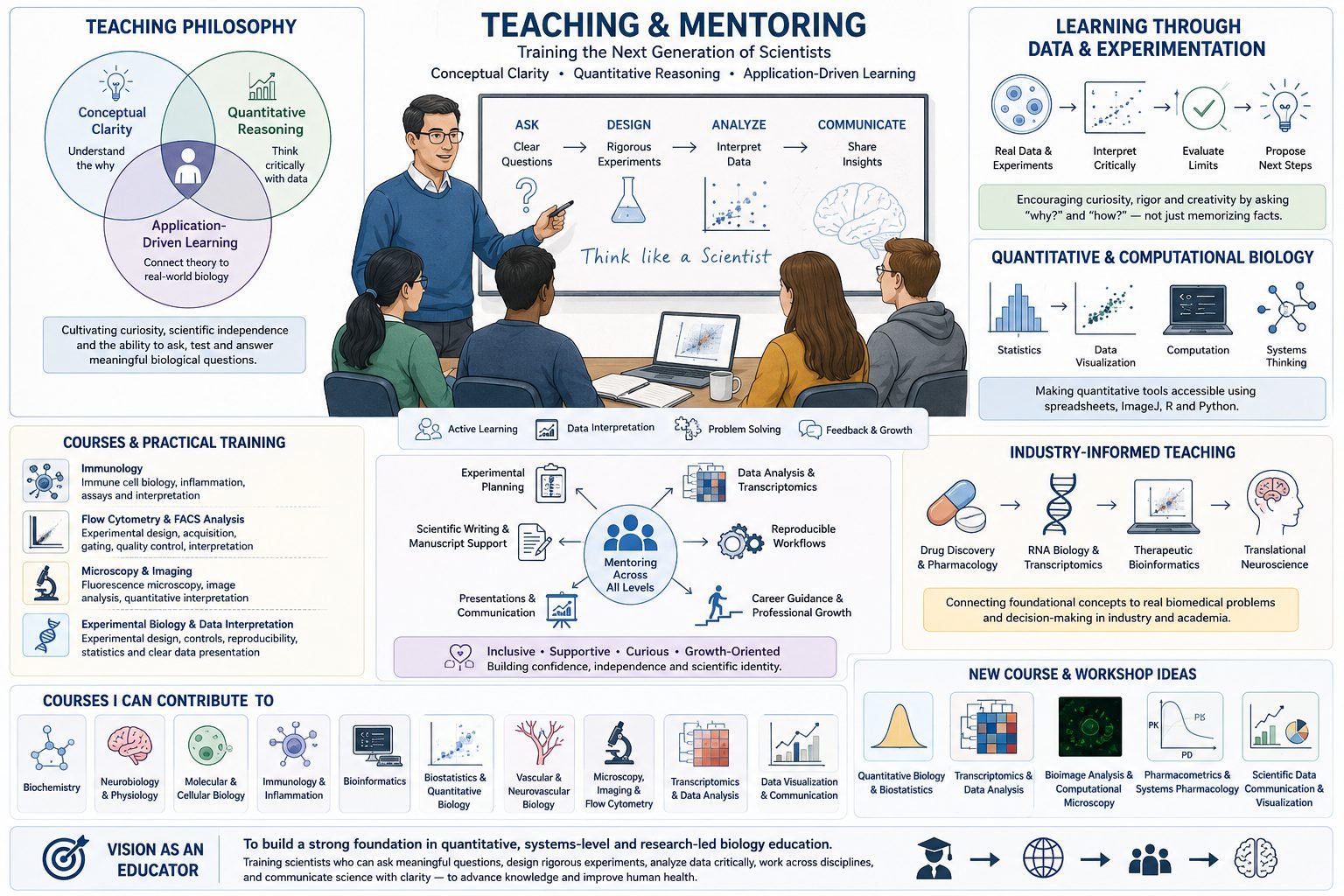
I have over eight years of teaching and mentoring experience across undergraduate, graduate, and research-training settings. My teaching focuses on helping students move beyond memorization toward scientific reasoning, quantitative thinking, and application-driven learning. I have taught and mentored in areas including immunology, flow cytometry, microscopy and imaging, experimental biology, transcriptomics, bioinformatics, and data interpretation.
My approach combines conceptual clarity with hands-on analysis, real experimental examples, and mentorship. I aim to train students to think like scientists: to ask clear questions, design rigorous experiments, interpret data critically, and communicate their findings with confidence.
Teaching, to me, is not simply the transfer of information. It is the cultivation of curiosity, scientific independence, and critical thinking. My teaching philosophy is guided by three principles: conceptual clarity, quantitative reasoning, and application-driven learning. I encourage students to understand why biological processes occur, how experiments are designed to study them, and how data can be interpreted to build scientific knowledge.
I view biology as an integrative and increasingly quantitative discipline, drawing from chemistry, physics, mathematics, computation and medicine. My goal as an educator is to help students develop a systems-level understanding of biology rather than relying on rote learning.
A central feature of my teaching is the use of real experimental examples. When teaching topics such as neurophysiology, cell signaling, immune responses, microscopy, or flow cytometry, I encourage students to interpret experimental results, identify appropriate controls, evaluate limitations, and propose follow-up experiments. I emphasize asking why and how rather than focusing only on factual recall.
I also use active learning methods such as guided discussions, data interpretation exercises, problem-based learning and formative feedback.
Modern biology is data-rich. High-throughput sequencing, imaging, flow cytometry and computational analysis have transformed how biological questions are asked and answered. I therefore believe quantitative literacy should be introduced early and made accessible to life science students.
In my teaching and mentoring, I introduce students to basic principles of statistics, data visualization, image analysis, and computational thinking — using accessible tools such as spreadsheets, ImageJ, R, or Python. My aim is to reduce intimidation around quantitative methods and help students see computation as a natural extension of biological reasoning.
In addition to formal teaching, I have mentored Master's students, PhD students, research trainees and junior scientists during my doctoral, postdoctoral and industry appointments — supporting them in experimental planning, data analysis, transcriptomic interpretation, scientific writing, manuscript preparation, reproducible workflows and presentation of research findings.
I strive to create an inclusive and supportive learning environment where students feel comfortable asking questions, challenging ideas, and learning from mistakes.
My experience in pharmaceutical research and biotechnology has strongly shaped my teaching interests. I frequently use examples from pharmacology, drug discovery, translational medicine, bioinformatics, RNA-seq analysis and disease biology to show how foundational concepts are applied in real biomedical problems.
My long-term teaching vision is to help build a strong foundation in quantitative, systems-level, research-led biology education. I want students to learn biology not only as a body of knowledge, but as a way of thinking.
Understand why biological processes occur — not merely that they do.
Statistics, visualization and computation as a natural extension of biological thinking.
Real experimental examples, real controls, real limitations, real follow-up experiments.
Courses
In development
Probability, statistical testing, experimental design, data visualization and biological interpretation.
Bulk RNA-seq, single-cell RNA-seq, preprocessing, visualization, differential expression and reproducible workflows in R or Python.
Quantitative image analysis using open-source tools such as ImageJ and Python.
Dose–response relationships, pharmacokinetics, drug action, translational modeling and industry case studies.
Presenting complex biological data clearly, accurately and visually.
Co-supervised two PhD theses and one Master's thesis at the University of Münster, and mentored junior scientists and doctoral researchers in experimental design, quantitative analysis, omics workflows, reproducible computation and manuscript preparation.