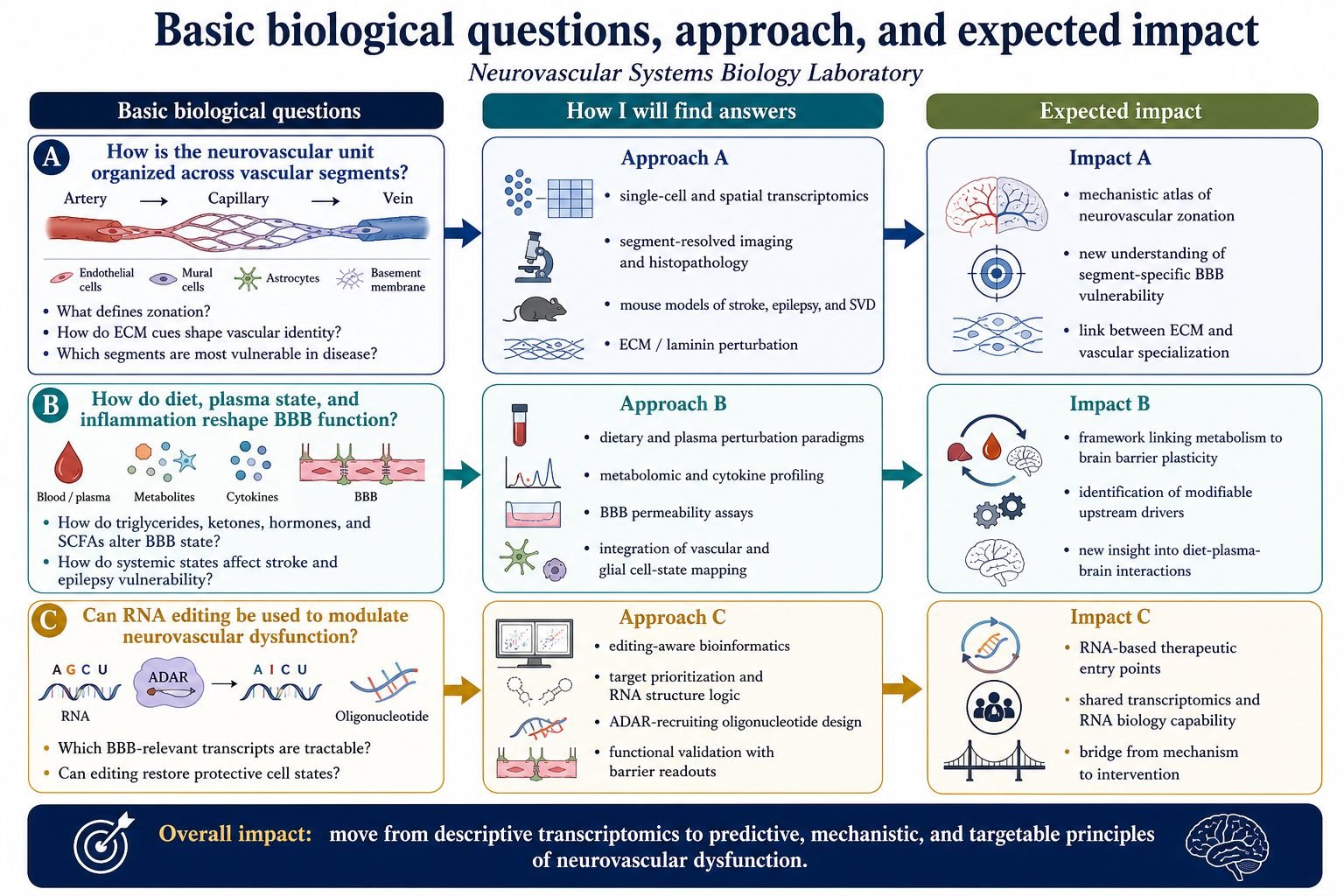
Where along the vascular tree does blood-brain barrier failure begin in stroke and epilepsy?
BBB dysfunction is not a uniform, capillary-only event — it is segment-specific across arterial, capillary and venous endothelial states.
How I will find answers
- Single-cell and spatial transcriptomics
- Segment-resolved imaging and histopathology
- Mouse models of stroke, epilepsy and SVD
- ECM / laminin perturbation
Expected impact
- Mechanistic atlas of neurovascular zonation
- New understanding of segment-specific BBB vulnerability
- Link between ECM and vascular specialization
The full rationale Show less
I hypothesize that blood-brain barrier dysfunction in stroke and epilepsy is not a uniform capillary-only event, but a segment-specific process involving arterial, capillary, and venous endothelial states. In this model, vulnerable vascular segments shift from a restrictive barrier program marked by junctional and transport regulators such as CLDN5, OCLN and MFSD2A toward a more permissive, transcytosis-associated state involving CAV1, CAVIN1 and related caveolar pathways.
I further propose that extracellular matrix composition, vascular basement membrane signals, mural-cell interactions and inflammatory stress determine where and when this switch occurs along the arteriovenous axis.
A central aim is to define whether arterial and arteriole-associated endothelial programs contribute directly to barrier instability, tissue vulnerability and disease propagation. I am particularly interested in whether disease-associated RNA editing events alter genes involved in endothelial transport, junctional stability, extracellular matrix signaling or mural-endothelial communication.